
Connect
© 2026 Kyekyekule Africa. All rights reserved.
kyekyekule.africa
© 2026 Kyekyekule Africa. All rights reserved.
kyekyekule.africa

Emmanuel Agyapong
Author
Published on:
October 8, 2026
The 9th edition of the Lubumbashi Biennale will take place from 15 October to 15 November 2026 in Lubumbashi, Democratic Republic of the Congo, bringing together 35 Congolese and international artists to examine the lasting effects of resource extraction on the land, its people and their stories.
The 9th Lubumbashi Biennale opens on 15 October 2026 in Lubumbashi, Democratic Republic of the Congo, bringing together 35 Congolese and international artists to examine the relationship between resource extraction, land, and cultural knowledge.
Curated by Sorana Munsya, the edition runs until 15 November under the title Eating the Soil / Manger la terre (kukuria bulongo), drawing on the knowledge of the land and the practices of the so-called “copper eaters” of the Katanga region.
The biennale considers what remains beyond the commercial value assigned to mineral-rich territory. Rather than approaching land primarily as a repository of resources, the exhibition explores the histories, relationships, and ways of understanding the world that connect communities to their environments.
Looking Beyond Mineral Extraction

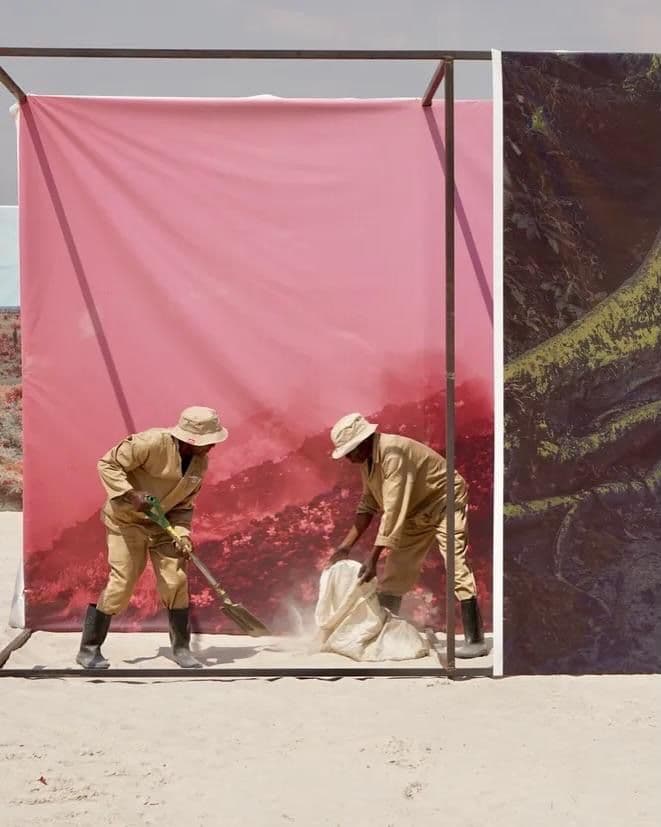
Léonard Pongo. Primordial Earth (2017 - ongoing). Complexe La Plage during the 6th Lubumbashi Biennale. Photograph by Julien De Bock
The Democratic Republic of the Congo is frequently discussed in relation to its mineral wealth and the environmental, political, and social consequences of mining. These accounts often frame the country through extraction, conflict, and crisis, leaving less room for the knowledge systems and cultural practices through which communities understand and inhabit their surroundings.
Eating the Soil addresses this imbalance without setting aside the material consequences of extractivism. Its curatorial approach asks how people continue to produce knowledge, sustain relationships, and imagine possibilities in territories shaped by the removal and commercialization of natural resources.
The title draws attention to the relationship between bodies, land, and the material conditions of life. Its reference to the “copper eaters” of Katanga places local knowledge at the centre of the exhibition’s inquiry, challenging interpretations of the region that privilege mineral value over lived experience.
Extraction, in this context, extends beyond the removal of physical resources. It also concerns the systems through which land and its inhabitants are interpreted, represented, and assigned value. The biennale turns towards the histories and practices that complicate those systems, asking what other forms of knowledge become visible when the land is understood through relationships rather than commodities alone.
Rethinking How We Understand the World
The curatorial framework draws on the work of Congolese philosopher Valentin-Yves Mudimbe, particularly the concept of indiscipline. This approach provides a way to question established systems of knowledge and examine the assumptions through which places, histories, and cultures are interpreted.
The exhibition also engages with the idea of fugitiveness, opening a discussion about possibilities that exceed systems of control and appropriation. Together, these concepts create a framework for considering how artistic practice can unsettle familiar accounts of the Congo and its resources.
Rather than proposing a single alternative narrative, the biennale brings different perspectives into a shared space of inquiry. Questions of territory, identity, history, and the future become connected to the ways knowledge is produced and whose experiences are recognized within dominant accounts of the world.
This approach gives the exhibition a broader scope than a critique of mining alone. It considers how artistic practices might make room for other ways of knowing and relating to land, particularly in places where extraction has shaped both material conditions and public narratives.
Bringing Together 35 Artists
The ninth edition features 35 artists and artistic collectives from the Democratic Republic of the Congo and the international art community. Their practices contribute different perspectives to the biennale’s examination of territory, resources, knowledge, and cultural imagination.
The participating artists and collectives are Antje Van Wichelen and Gustave Fundi Mwamba (Fm), Beau Disundi, Carl Kabila, Cécile Massart, Chimurenga, Christian Kabalu (Kabel), Christian Nyampeta, Djuma Birongo, Edmond Salumu, Félix Shumba, Grady Bizaki, Ghislain El Magambo Bin Ali Gulda, Jenny Kongolo, Jordyctionnaire, Joseph Kasau, Joud Toamah, Kevin Kabambi, Kris Verdonck, Lafleur & Bogaert with Willy Ilumbo, Magellan Kahozi, Malkia Mutiri, Mukenge/Schellhammer, Melisa Kayowa, Mirhego Akitowa, Nathan Bushiru, Némo Camus, Noor Abed, Ruth Mpombo, Sahil Naik, Sandra Mujinga, Séraphine Mbeya Nawej Matemb, Sikasso, Sôn Gweha, Victor Gama, and William Kentridge.
The range of participants places artistic practices from the region in conversation with work developed across different geographical and cultural contexts. Within the biennale’s framework, this diversity offers multiple ways to approach the relationships between land, extraction, memory, and the production of knowledge.
A Biennale Rooted in Lubumbashi
Founded in 2008, the Lubumbashi Biennale emerged from Picha, an art collective established in the city that has since developed into an art and research centre. Picha supports contemporary art in the region while creating opportunities for exchange between Congolese and international artists.
Artist Sammy Baloji, a co-founder of Picha, helped establish the biennale alongside cultural practitioners including George Senga, Rosa Spaliviero, and Jean Katambayi. Its development reflects a sustained effort to build spaces for artistic production, research, and public engagement in Lubumbashi.
Beyond the biennale, Picha organises Ateliers Picha, a programme of residencies, workshops, exhibitions, and research projects. These activities provide opportunities for artists to develop their practices and engage with different audiences, contributing to the city’s contemporary art infrastructure.
The biennale therefore operates within a longer institutional effort to support artistic work and exchange in the region. Its focus on extraction is closely connected to Lubumbashi’s historical and geographical context, where mining has shaped economic activity, the environment, and relationships with the land.
What the Land Holds Beyond Its Resources

Nathan Bushiru's Home series (2023). Photography. Credit: Nathan Bushiru
With Eating the Soil, the Lubumbashi Biennale places questions of extraction alongside those of knowledge, cultural memory, and the ways communities relate to their environment. Its curatorial framework challenges readings of the Democratic Republic of the Congo that begin and end with mineral wealth, turning attention towards the people and practices that complicate those narratives.
The exhibition’s significance lies in how it connects a specific regional history to wider questions about value, representation, and the systems through which land is understood. By bringing together artists working across different contexts, the biennale creates a space to examine what extraction leaves behind—and what forms of knowledge and cultural life continue beyond its logic.
The 9th Lubumbashi Biennale runs from 15 October to 15 November 2026 at 7, Avenue du Parc, Lubumbashi, Democratic Republic of the Congo.
October 16, 2026
October 10, 2026

October 7, 2026

October 7, 2026