
Connect
© 2026 Kyekyekule Africa. All rights reserved.
kyekyekule.africa
© 2026 Kyekyekule Africa. All rights reserved.
kyekyekule.africa

Emmanuel Agyapong
Author
Published on:
July 6, 2026
Gabriel Selassie Tsagli’s Son of Kafui, opening at Gallery 1957 in Accra on 23 July 2026, begins with a return.
Gabriel Selassie Tsagli’s Son of Kafui, opening at Gallery 1957 in Accra on 23 July 2026, begins with a return. It is a return to the city where he was born, to the memory of his late mother, and to questions of family and belonging that become newly complicated through his experience of raising a daughter. Curated by Marina Paulenka, the exhibition marks Tsagli’s first solo presentation in Ghana and his first exhibition with Gallery 1957 following his residency with the gallery.
The exhibition takes its title from his mother, Kafui, a name associated with love and the divine. Her absence provides an important point of departure for the new body of work, but Son of Kafui is not simply an exhibition about mourning. Developed after Tsagli returned to Accra in 2025, the paintings emerge from the intersection of loss and a new form of responsibility: becoming a father himself. Memory consequently moves in two directions, toward the mother he remembers and toward the daughter whose presence is shaping the next generation of his family.
This movement between generations is central to the exhibition. Grief can often be understood as a relationship with what has been lost, but Tsagli’s experience introduces another temporal dimension. Raising a young daughter places him in the position of both remembering a parent and becoming one. The memory of his mother is therefore encountered alongside the practical and emotional realities of fatherhood, creating a space in which inheritance is not only something received but something actively carried forward.
Tsagli’s biography has long been shaped by movement between places. Born in Accra and raised between Ghana and Germany, he has developed a practice attentive to the instability and complexity of belonging. His paintings move between figuration and abstraction, using layered surfaces, colour, and texture to approach experiences of identity and memory that do not always resolve into a single image. In Son of Kafui, that movement takes on a more intimate register as the question of where one belongs becomes connected to the people through whom home is remembered.

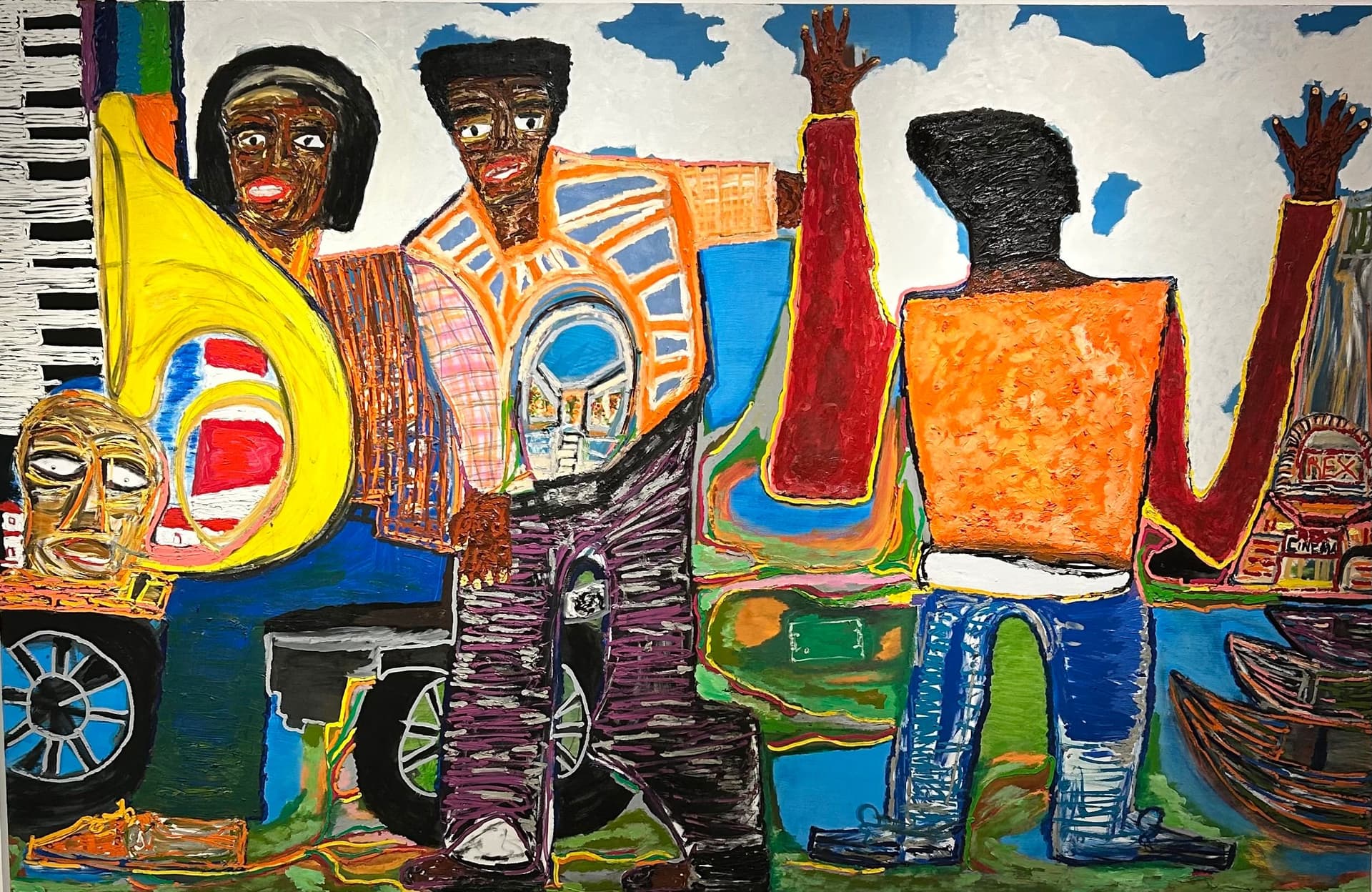
Gabriel Selassie Tsagli, Blue notes, 2026, Pastel, wall colour and oil on wood, 245 x 305 cm. Courtesy of the Artist and Gallery
His approach to painting also reflects this relationship between structure and feeling. Tsagli describes his process in terms comparable to musical composition, allowing colour and emotion to determine the movement of a work rather than treating the canvas as a fixed plan. This gives the paintings room to hold contradiction: presence alongside absence, memory alongside experience, and the past alongside an emerging future. Figuration can establish a recognisable point of connection, while abstraction allows what cannot be fully represented to remain present through colour, gesture, and material.
The idea of home consequently extends beyond geography. Returning to Accra does not simply mean returning to a birthplace. It becomes a way of approaching family histories and the emotional structures attached to a place. For someone whose childhood and adult life have crossed Ghana and Germany, home can exist simultaneously as location, memory, language, relationship, and inheritance. Son of Kafui uses painting to move through these different forms of belonging rather than resolving them into a single definition.
The exhibition’s title also places the artist within a lineage. To be a “son of Kafui” is to be identified through a maternal relationship, even as Tsagli is now experiencing parenthood from another position. The title therefore carries both memory and continuity. It names a relationship to someone who is absent while affirming the fact that what is inherited from that relationship continues to shape the person who remains.
Tsagli’s statement, “We are not building new worlds. We are building new words to allow the old to pass perfectly,” offers another way into the exhibition. The line suggests that inheritance is not necessarily about reproducing the past unchanged. It is about finding forms through which what came before can continue to move into the present. Painting becomes one such form: a way of translating memories, relationships, and experiences that cannot simply be preserved as they were.
This makes Son of Kafui less a return to the past than an examination of how the past remains active in the present. The memory of a mother changes when one becomes a parent. A birthplace changes when it is revisited as an adult. Family history changes when it is understood not only as something inherited, but as something that will eventually be passed on.
When Son of Kafui opens in Accra, its central question will therefore extend beyond grief. It asks what happens to memory when it is carried across places and generations, and how becoming a parent can alter one’s understanding of the person who once occupied that role. In Tsagli’s paintings, return becomes less about recovering what has been lost than about recognising what continues to live through us.
October 18, 2026

October 7, 2026

October 3, 2026
September 29, 2026