
Connect
© 2026 Kyekyekule Africa. All rights reserved.
kyekyekule.africa
© 2026 Kyekyekule Africa. All rights reserved.
kyekyekule.africa

Emmanuel Agyapong
Author
Published on:
June 29, 2026
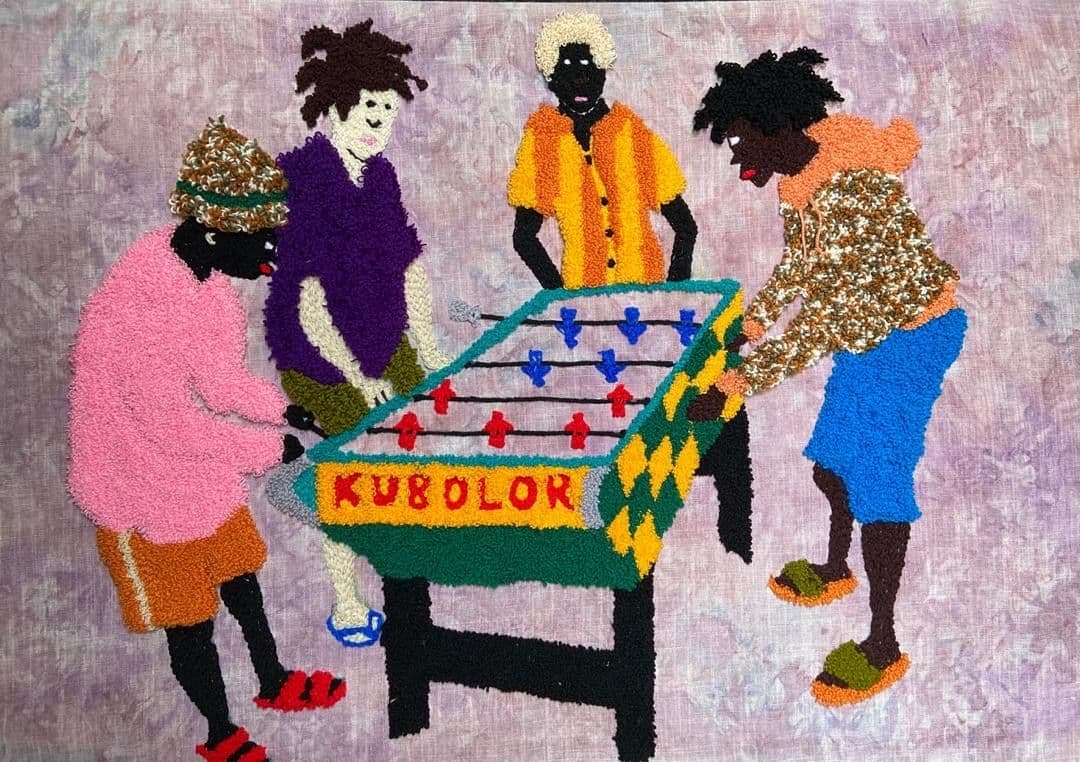
Ghanaian artist Gideon Kwabena Amponsah places that figure at the centre of his latest solo exhibition, KUBOLOR: In Search of Greener Pastures, currently on view at LAFA. The exhibition opened with a reception on 27 June and remains open to the public until 25 July 2026.
What does it mean to be called a Kubolor?
In Ghanaian popular language, the word can describe someone who moves freely through the streets, living outside the routines and expectations that organize more conventional forms of social life. The figure of the Kubolor occupies a complicated position: free-moving but often misunderstood, visible everywhere yet not always fully recognised as belonging anywhere.
Ghanaian artist Gideon Kwabena Amponsah places that figure at the centre of his latest solo exhibition, KUBOLOR: In Search of Greener Pastures, currently on view at LAFA. The exhibition opened with a reception on 27 June and remains open to the public until 25 July 2026. Through textile and mixed-media works, Amponsah turns the idea of the Kubolor into a broader inquiry into movement, survival, identity, and the search for possibility.
Rather than treating the term as a simple description of life on the margins, the exhibition reconsiders what the Kubolor can represent. Movement becomes a form of knowledge. To move through a city is to learn its rhythms, its opportunities, its dangers, and its invisible boundaries. The person searching for greener pastures is not simply travelling from one place to another; they are constantly adapting, negotiating, and finding ways to survive within changing circumstances.
This gives the exhibition’s title a wider resonance. “In Search of Greener Pastures” speaks directly to migration and the desire for better opportunities, but it also describes a condition familiar to many people navigating contemporary urban life. The search for a better future does not always require crossing national borders. Sometimes it takes place within the same city, across neighbourhoods, social classes, professions, and systems of opportunity.
In Amponsah’s work, the city is therefore more than a backdrop. It becomes an active force in the formation of identity. Its streets produce encounters. Its pressures demand adaptation. Its promises encourage movement. The urban environment becomes a place where people continually construct and reconstruct themselves according to what is possible.
The use of textile and mixed media is particularly suited to this sense of accumulation and transformation. Materials carry histories of their own, and when brought together, they can reflect the layered nature of the experiences Amponsah is exploring. Identity, like the city itself, is not presented as fixed. It is assembled through movement, memory, struggle, encounter, and improvisation.

Gideon Kwabena Amponsah, AGURO FIE, 4”x3.5” 2024. Courtesy of the Artist
KUBOLOR also expands beyond the conventional boundaries of the gallery through a collaboration with fashion designers Herbert Adjei Darko and Welbert Adjei Darko of DARKOS. Together, the artists have developed wearable pieces that carry the exhibition’s ideas into fashion and performance. This extension is significant because clothing is itself one of the most immediate ways identity is made visible in public space.
To move through a city is also to be seen. What someone wears can influence how they are read, welcomed, ignored, admired, or judged. By bringing fashion into the project, KUBOLOR extends its exploration of movement into the body itself, considering how identity travels through public space and how the individual becomes visible within the larger social landscape.
Curated by Kwamena Boison and Nuna Adisenu-Doe, the exhibition brings these different concerns together around a figure who resists easy definition. The Kubolor can represent freedom, uncertainty, marginality, resilience, and possibility at the same time. That complexity is precisely what makes the term productive as a starting point for an exhibition.
Ultimately, KUBOLOR: In Search of Greener Pastures asks viewers to reconsider what movement means. Is movement always a sign of freedom, or can it also be a necessity? What does it mean to belong to a place while constantly searching for somewhere better? And how much of identity is formed not by where we finally arrive, but by everything we encounter along the way?
In Amponsah’s hands, the Kubolor becomes more than a person moving through the streets. It becomes a way of understanding life itself: as a continual negotiation between where we come from, where we are, and the greener pastures we are still searching for.
October 18, 2026

October 7, 2026

October 3, 2026
September 29, 2026